
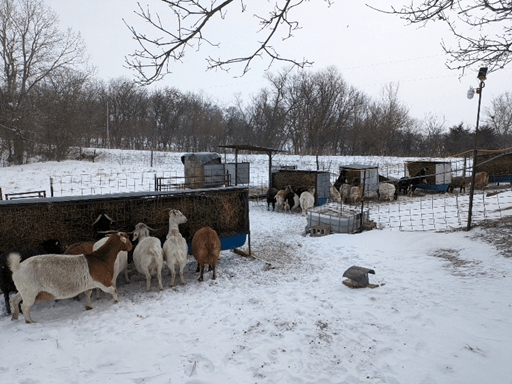
It’s that time of year again, the 3rd trimester nannies are off of corn stalks and in confinement, getting 100% of their nutrients delivered to them. I’ve traditionally fed 100% of their dry-matter requirements with a metered amount of mid-quality alfalfa hay. This year I have been wondering if I should move more to a mix of alfalfa and lower-quality roughage, like corn stalk bales or low quality grass hay. I thought I’d share how this pencils out here.
I don’t feed any grain or pellets. Ruminants require 3% of their body weight per day in dry matter. These are pregnant does, so at least 13% of that 3% must be digestible protein.
Mid-range alfalfa is going to be about 16% protein, and as mentioned, I’m feeding them 100% of their dry matter requirement. In other words, for every 100lbs of goat, I am feeding 3lbs per day of alfalfa. For every 10,000lbs of goat, I am feeding 300lbs.
If I start mixing in another feed type, I’m going still be feeding that same 3%, the main trick is to make sure that protein stays at or above 13%, preferably with some margin for error.
First, lets take a look at doing a 60/40 mix with low quality grass hay. This mix does get enough protein and offers decent savings.

I have a spreadsheet I use for this, but the math is fairly simple. The “mix” row should always add up to 100%, for each column, take the mix percent multiplied by the protein percent of the base feedstuff to get the “protein share”. Add those together for each column and you get the “mix protein”.
Protein: (0.18 * 0.6) + (0.08 * 0.4) = 0.14
Now let’s substitute lower cost corn stalks. This is running a lot closer to minimum protein levels, a little too close for comfort for late-gestation/early lactation nannies in my opinion. You could offset this with higher quality alfalfa or a smaller share of corn stalks, or a number of other means.

Calculating cost is pretty similar to protein. Multiply the “Cost” by the mix percent for the column, add all columns together. The “Savings” row is compared to straight alfalfa. All costs are on a per-ton basis.
Cost: (130 * 0.6) + (40 * 0.4) = 94
There are other things I could do to improve feed efficiency, if I was so inclined. Nannies carrying twins have lower nutritional requirements and could be fed less and lower quality, singles even more so, just for an example.
These examples only cover crude protein, not Total Digestible Nutrients (TDN) which should also be considered, and is calculated using the same basic equations. You can find protein and TDN requirements for animals at different life/production stages from sources online, but keep in mind that different breeds, ages, living conditions, and genetics will perform differently. You should always be monitoring body condition of your animals, especially when making feed changes, and be prepared to revert or modify those changes if you are beginning to see issues. All of this is only theory, and reality always wins!
Originally published Feb 2025
 Nebraska Sheep and Goat Producers
Leave a comment